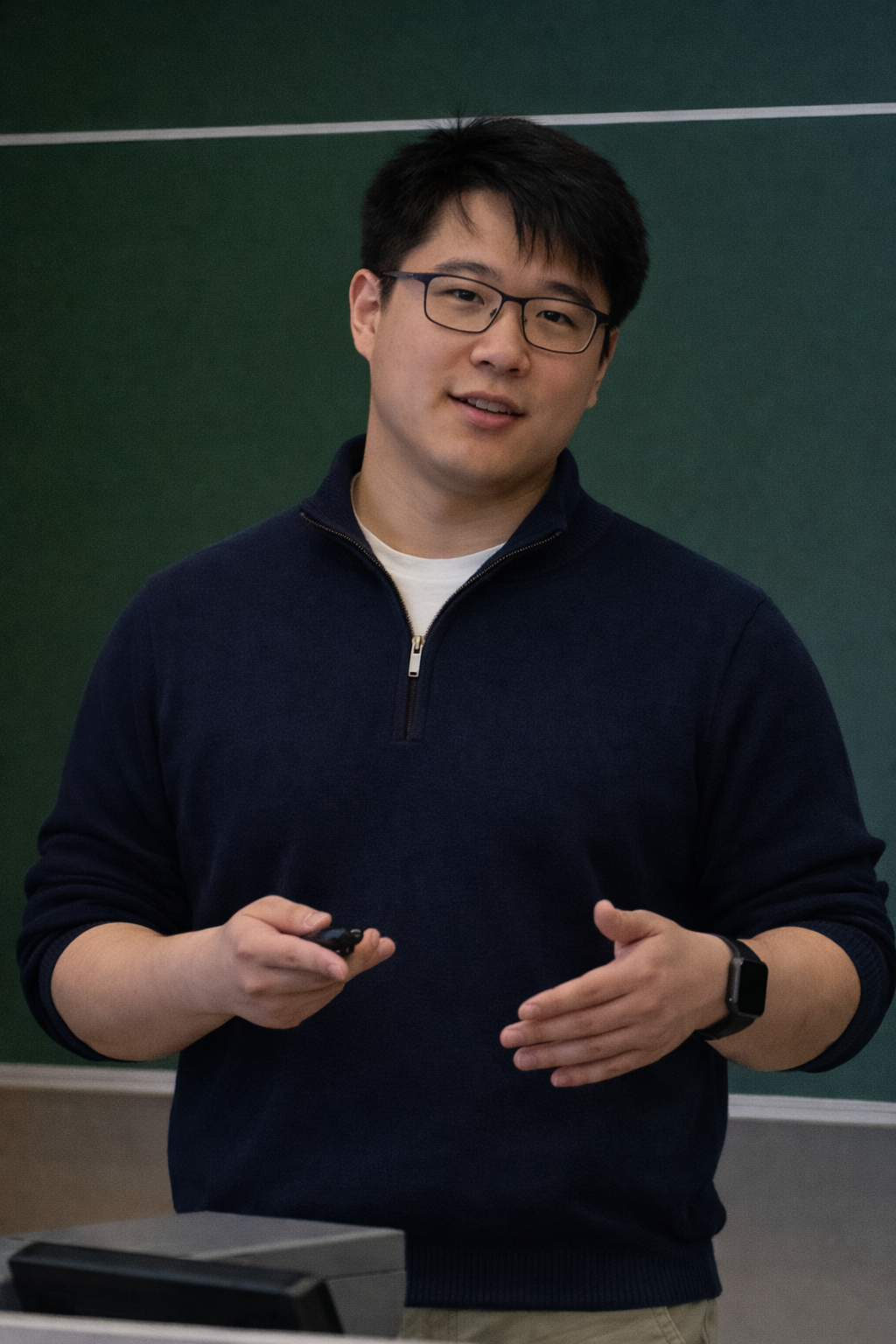
About Me
I am a PhD candidate at the Karlsruhe Institute of Technology working at the intersection of machine learning, signal processing, and experimental physics, with a focus on methods that translate reliably from theory into real systems. Previously, I studied physics at Brandeis University and electrical and computer engineering at Olin College, and worked on CMS-related projects at MIT, Fermilab, and CERN. Through these experiences, I developed a strong appreciation for end-to-end systems: filtering pipelines, real-time reconstruction, and distributed computation that must perform reliably in production-like settings.
Current Research Focus
Hybrid ML–Likelihood Pipelines for Time-Series Reconstruction and Triggering
Built time-series reconstruction and triggering pipelines under noise and latency constraints, using attention-based
models for event reconstruction, likelihood-based parameter estimation, and reinforcement learning for sequential
triggering decisions under uncertainty.
Unified maximum-likelihood estimators for anomaly detection in time-series data under realistic noise and deployment constraints.
Developing unsupervised and weakly supervised detectors that connect Optimal Filtering (OF), EMPCA, and linear autoencoders as equivalent or closely related inference mechanisms under different noise and model assumptions. These approaches are used to identify rare, nonphysical, or pathological signal morphologies in large-scale time-series datasets, with increasing attention to low-precision and bit-level computation to enable stable, efficient deployment.
Supporting infrastructure for scientific ML workflows, including data handling, experiment reproducibility, and resource scheduling, primarily in research-scale environments rather than production systems.
Building containerized and distributed workflows using tools such as HTCondor, JupyterHub, and GPU clusters
to support reproducible training, large-scale inference, and rapid iteration in collaborative environments.
Technical Interests
My interests lie at the boundary between physical systems and computation, particularly where models must operate under real-world constraints.
- Representation learning for time series, including self-supervised learning on large volumes of unlabeled data
- Simulation-based and likelihood-free inference, with emphasis on flow-based and amortized methods
- Signal reconstruction pipelines that embed known structure while retaining flexibility through learning
- Low-latency and real-time inference for high-throughput experimental or sensing systems
- Sequential decision making and reinforcement learning under uncertainty and partial observability
I am especially drawn to approaches that preserve physical structure, remain numerically stable, and can be deployed and maintained in operational environments.
Contact
Email is the best way to reach me:
dowlingwong@gmail.com
You can also find research code and side projects on GitHub, and a more formal summary of my background in my CV and LinkedIn profile.